Origin Stories
Claude the Investment Banker?
Last week, I wrote about how AI's breakout success in software engineering would be hard to replicate across the rest of knowledge work. Tasks fall on a spectrum from deterministic (objective right answer, machine-checkable) to non-deterministic (judgement, ambiguity). Coding sits at the deterministic end, which is why it went first.
Anthropic claims to have found the next target: on Tuesday, they released "Agents for Financial Services."
And in a true power move, the launch was accompanied by a 1.5 hour launch event, including an interview with Dario Amodei and Jamie Dimon moderated by Andrew Ross Sorkin. (JPM is obviously vying for that “lead left” role on the Anthropic IPO.)
If you have time, I highly recommend watching it. But if you don't, here's what you need to know.
1. Finance is 6-12 months behind coding
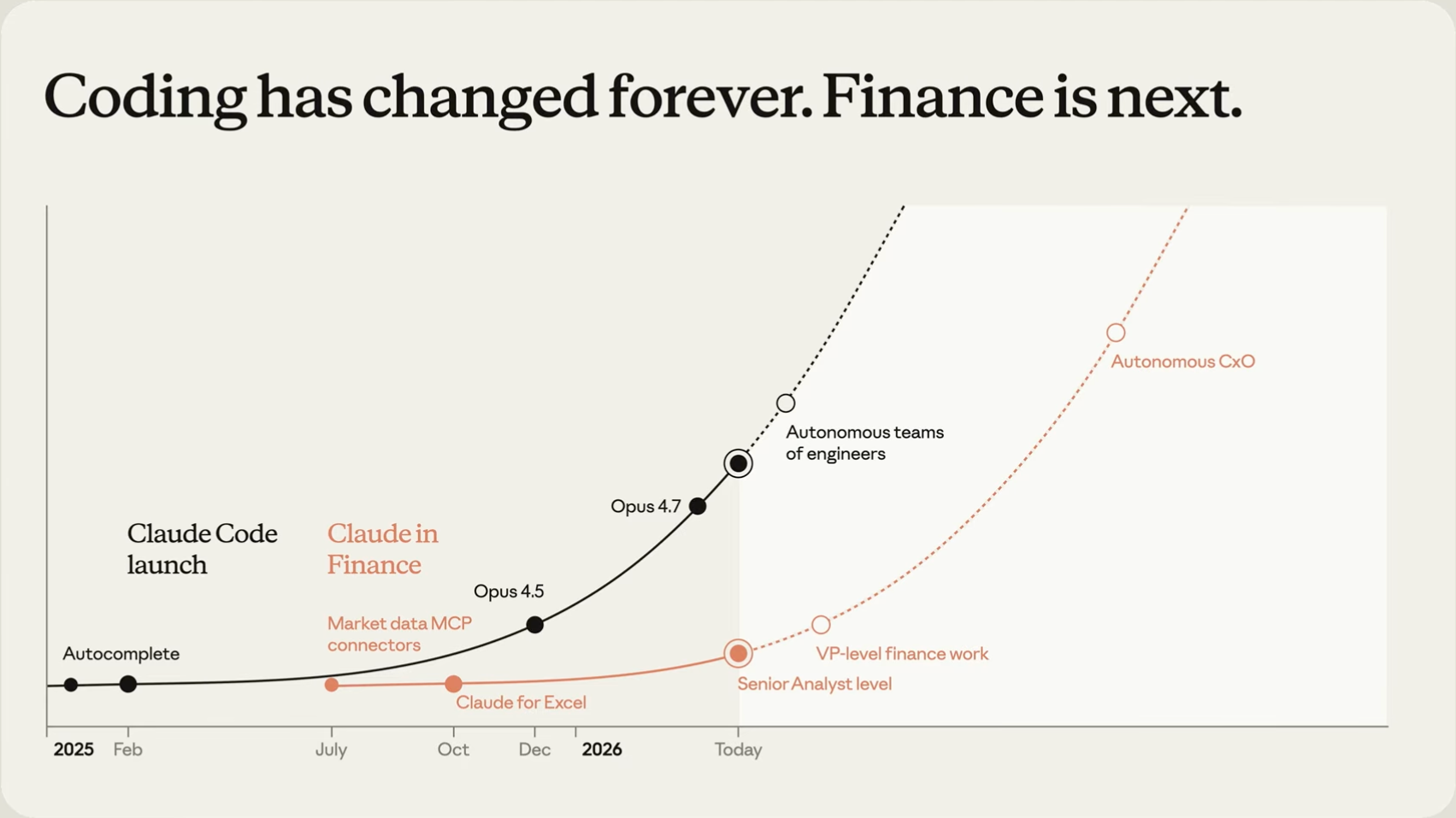
This was the headline claim. Lisa Crofoot, a research product management leader at Anthropic, put it plainly: finance "took off relatively later, but we believe we're at the inflection point right now, about six months to one year behind coding." Less than a year ago, Claude "could barely create an excel table without #ref errors." Today, it can complete senior-analyst-level work.
The reference point is software engineering. 18 months ago, coding was in the “autocomplete” phase; today, autonomous software engineers handle whole projects end-to-end. Finance is set to climb the same curve.
2. Improvements in coding are driving the improvements in finance
Most finance work is numbers, and thus deterministic. Whether you're a PE rainmaker or working in back-office, the shape of finance work is consistent: pull data and manipulate it in Excel, format it into PowerPoint, email to someone. DCF models, derivatives pricing, KYC, statement audits, month-end closes - these are all formulaic tasks where there is, broadly, a correct answer.
So as AI gets better at coding, it naturally gets better at the raw skills necessary in finance. Code is how AI interacts with its world (your computer). As it gets more capable, it can start to work within the other applications and tools you need it to work in.
The agents Anthropic released this week (Pitch Builder, Earnings Reviewer, Model Builder, KYC Screener, Month-End Closer, etc) are essentially Claude Code re-skinned for spreadsheets and pitch decks. The challenge for finance was never math. It was getting the model into the places where the work actually happens: Excel, Word, PowerPoint. With that solved, finance is on its way up the curve.
3. The real magic isn't intelligence. It's autonomy.
You’ve probably heard the term “scaling laws” in AI. It refers to the huge performance gains that come from significantly increasing the resources you throw at training the model: compute, data, and the model’s “size” (ie number of internal parameters that can be calibrated).
Of course, as the models scale they get smarter. But what allows for this breakout success in usefulness and productivity isn’t just increasing intelligence, it’s increasing autonomy.
Two years ago, Claude moved out of the chatbot and started using tools. Last year, it demonstrated the capacity to work on PowerPoints and edit Excel. The latest models show emergent judgement on ambiguous tasks over longer time horizons.
They can take an ambiguous instruction, break it down into smaller tasks, delegate and execute those tasks, and then decide for themselves how best to evaluate their own work, and then go back and iterate if necessary to get to a better result. It’s way beyond a chatbot answering a question. That's an intern executing a project.
If you've ever managed an intern, you'll know that intelligence isn't the rarest commodity. Plenty of junior people are smart. The thing that makes someone genuinely useful is autonomy — the ability to take an ambiguous brief, work on it for hours unsupervised, and come back with something usable.
Anthropic showed a great example of this in their demo: an LBO analysis for a client that previously would have relied on a poor analyst giving up her weekend to complete a model and create a deck. Now, handled entirely end-to-end by Claude.
4. The bottleneck is no longer technology, it’s adoption
Anyone who’s ever sold technology into the financial services industry knows that “the tech” is not the hard part. It’s the friction of procurement, compliance, infosec, and everything else that large organisations set up to ensure safety and security.
Yes, the anecdotes from GS and JP are impressive. But those two firms have always lived on the bleeding edge of tech compared to their peers (and they have plenty of other reasons to dive in head first - *ahem* IPO *ahem*).
But for the rest of the industry, the familiar messiness of change management in enterprise is going to continue to be the bottleneck. And with tech that is this powerful, firms are definitely going to proceed with caution before unleashing this level of autonomy within their 4 walls.
Also, over here in Europe, the spectre of “sovereignty” is definitely going to loom large.
Every European bank evaluating a US AI vendor is also evaluating where the data sits, which jurisdiction's law governs the model, and what happens if the geopolitical climate keeps deteriorating. And the European regulators will almost definitely have a view.
5. So what's left for SaaS?
The most interesting moment of the keynote was when Sorkin asked what happens to existing enterprise software.
Jamie made the point that “a lot of these software companies are already adding agents to what they do. It may be easier to take their software, add the agent, and use that rather than trying to [rebuild everything].” For a large enterprise with multiple vendors, long contracts, and a cautious change management process, that sounds like a likely outcome.
Dario was direct. He called himself a “maximalist” in terms of the model’s ability to write code. "If your moat is 'our software is complex and difficult to write, and we can write it, and others can't match it' - I think that's going away." Later, "It's very possible for [individual SaaS companies] to lose market value, go bankrupt, completely go bust."
But companies have plenty of other moats: network effects, proprietary data, deep workflow integration, compliance, customer relationships, domain expertise. As he puts it, the best companies are going to identify which of their moats are strongest and which are going away, pivot towards the strong moats, and will end up thriving and doing better than ever before. Others who don’t pay attention are going to be “blindsided.”
For DCM technology specifically, the moats that matter are the ones AI doesn't dissolve: real connectivity to issuers and buyers, relationships built over years. Founders who've spent the last decade building those things should feel good this week. The ones wrapping a thin UI around an open-source library, less so.
In any case, the intersection of finance and technology looks set to get very exciting over the next 2 years. Buckle up!